
What Is Anti-Drone Nets/Mesh?
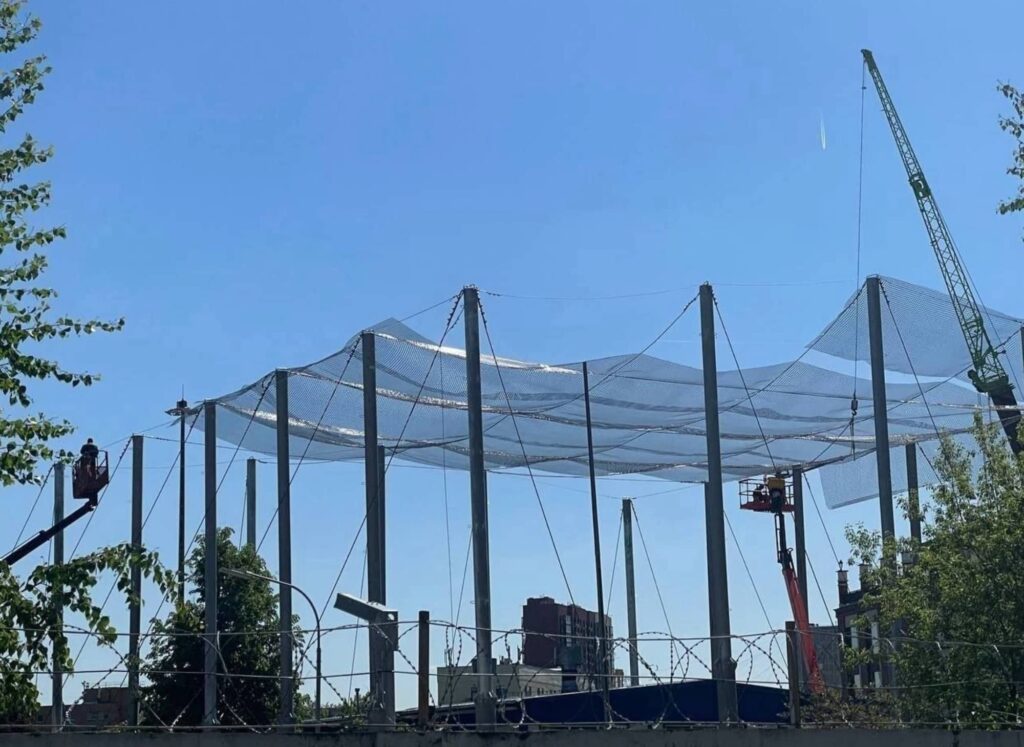
As commercial drones become smaller, cheaper, and easier to deploy, governments and private security operators face increasing challenges protecting sensitive infrastructure from low-altitude UAV threats. Traditional radar and missile defense systems are often expensive and inefficient against small FPV drones or autonomous UAVs flying pre-programmed routes with no active radio communication.
This has created growing demand for anti-drone nets and mesh systems — a practical, cost-effective physical barrier solution capable of intercepting hostile drones before they reach protected targets, without relying on spectrum authorization or electronic intervention.
What Are Anti-Drone Nets?
Anti-drone nets are specially engineered mesh systems designed to physically block, entangle, or disable drones and UAVs. These systems are commonly manufactured using high-strength materials such as HDPE, nylon mesh, stainless steel cable, galvanized wire rope, or Kevlar-reinforced structures, depending on the threat level and deployment environment.
The mesh creates a physical interception barrier around sensitive infrastructure — either as a vertical perimeter, an overhead canopy, or a combined enclosure — preventing drones from accessing restricted airspace or delivering payloads to protected targets.

Why Anti-Drone Protection Is Important
Modern drones are increasingly used in surveillance, reconnaissance, smuggling, explosive delivery, and infrastructure sabotage operations. Low-altitude UAVs are difficult to detect using conventional air defense systems because of their small radar cross-section and flexible, low-altitude flight patterns.
- Military reconnaissance and FPV attack drones
- Unauthorized intrusions into airport controlled airspace
- Drone-based contraband and smuggling operations
- Critical infrastructure sabotage risks
- Autonomous border surveillance and payload delivery
- Commercial drones repurposed for explosive payload drops
Unlike missile systems or directed-energy weapons, anti-drone mesh provides protection at a fraction of the cost, with no power requirement, no spectrum licensing, and no trained operator needed during active interception.
How Anti-Drone Mesh Systems Work
Anti-drone mesh systems create a protective interception zone above or around sensitive areas. The effectiveness comes from three core physical mechanisms working in sequence:
Propeller Entanglement
When a rotor contacts the mesh, the netting wraps around the blade assembly within milliseconds, causing immediate motor stall. Most consumer and commercial drones cannot generate enough torque to break free once entangled, and continued attempts accelerate mechanical failure.
Velocity Reduction and Impact Absorption
A mesh with appropriate elasticity and surface area absorbs the kinetic energy of an intercepted drone, reducing descent velocity and impact force on the ground below — critical when protecting crowds, vehicles, or sensitive equipment.
Structural Containment
In configurations where the mesh forms a continuous enclosure — such as a canopy over an ammunition depot or a perimeter net around a facility — the drone is retained within the structure after interception, preventing secondary hazards from fragmented components or unstable batteries, and preserving the unit for forensic recovery.

Main Types of Anti-Drone Nets
Overhead Protection Nets
Installed above ammunition depots, military vehicles, aircraft parking zones, and temporary field camps to stop vertical drone attacks and airborne payload drops. The horizontal canopy configuration intercepts descending UAVs regardless of approach angle.
Perimeter Anti-Drone Mesh
Used around airports, government compounds, oil refineries, and power plants to create vertical restricted aerial access zones along facility boundaries. Can be integrated with existing perimeter fencing infrastructure.
Steel Cable Drone Barriers
Heavy-duty galvanized or stainless steel cable mesh systems designed for permanent outdoor deployment in high-security military and industrial environments requiring long service life and resistance to weather, UV exposure, and sustained wind loads.
Portable Tactical Drone Nets
Lightweight modular systems suitable for mobile security teams, temporary checkpoints, forward operating bases, and event security deployments where the protection requirement is time-limited and the system must be erected and removed quickly.
Applications of Anti-Drone Mesh Systems
| Industry / Sector | Primary Protection Objective |
|---|---|
| Military Bases | Prevent UAV reconnaissance, FPV attacks, and explosive payload delivery |
| Airports | Protect runway operations and aircraft from drone intrusion |
| Oil & Gas Facilities | Reduce aerial sabotage and surveillance intrusion risks |
| Power Plants | Protect critical energy infrastructure from drone-based attack |
| Correctional Facilities | Block drone-based contraband delivery over perimeter walls |
| Border Security | Prevent cross-border drone smuggling and aerial surveillance |
| Event Security | Temporary overhead protection for stadiums and public gatherings |
Advantages of Anti-Drone Netting
- Cost-effective compared with missile or directed-energy interception systems
- Passive 24/7 protection — no power supply or active monitoring required
- Fully resistant to electronic countermeasures and signal disruption
- Effective against autonomous drones with no active radio communication
- Scalable from single structure coverage to large-area perimeter systems
- Compatible with multi-layer security architectures alongside radar and RF detection
Explore our full range of anti-drone net and mesh systems for military and industrial applications.
View Products →The Future of Anti-Drone Defense
As drone technology evolves — with smaller form factors, longer battery life, and greater autonomous capability — anti-drone protection systems are advancing in parallel. Current development directions include smart sensor integration for automatic threat detection, AI-assisted drone classification, lightweight composite mesh materials with improved strength-to-weight ratios, and hybrid electronic-physical interception architectures.
Many modern defense strategies now combine radar detection, RF jamming, optical surveillance, and physical anti-drone mesh barriers into multi-layered security architectures. In this model, the mesh serves as the final physical enforcement layer — ensuring that even undetected or signal-silent UAVs are stopped before reaching the protected zone.
Conclusion
Anti-drone nets and mesh systems have become a foundational component of modern security infrastructure. Their ability to provide reliable, low-cost, and passive UAV interception — without dependence on electronics, spectrum licensing, or operator response time — makes them uniquely valuable for military installations, airports, energy facilities, and critical infrastructure worldwide.
Frequently Asked Questions
What materials are used in anti-drone nets?
Common materials include HDPE, nylon mesh, stainless steel cable, galvanized wire rope, and Kevlar-reinforced netting. Material selection depends on the threat profile, deployment environment, and required service life.
Can anti-drone mesh stop FPV drones?
Yes. Properly engineered anti-drone mesh systems can physically intercept and disable FPV drones and low-altitude UAVs. Mesh aperture size is specified to match the rotor diameter of the target threat class.
Does anti-drone mesh work against autonomous drones?
Yes — this is one of its key advantages over electronic countermeasures. A drone flying on a pre-programmed autonomous flight path with no active radio communication cannot be jammed or spoofed. A physical mesh stops it regardless of its communication or navigation state.
Where are anti-drone nets commonly used?
They are widely deployed in military bases, airports, border checkpoints, oil and gas facilities, power plants, correctional facilities, and government compounds. Portable configurations are also used for event security and mobile operations.
How is anti-drone mesh installed?
Permanent systems are anchored to fixed infrastructure using tensioned cable systems, mast arrays, or building-integrated mounting. Temporary deployments use modular pole systems or vehicle-mounted frames that can be erected and removed within hours.